If you run your business from home, you may be able to claim part of the cost of running your home as a business expense.
This can apply to sole traders, freelancers, consultants, contractors and members of qualifying partnerships.
But there is an important distinction between working from home and being able to claim a percentage of every household bill.
Table of Contents
ToggleYou cannot simply decide that you use 25% of your home for business and claim 25% of everything you spend.
Your claim needs to have a reasonable basis and reflect how the home is actually used for your business.
For eligible self-employed businesses, there are two main ways to calculate home-working expenses:
- Calculate the actual business proportion of your household costs, or
- Use HMRC’s simplified expenses method, where the fixed monthly rate is based on the number of hours you work from home.
The best method is not necessarily the one that is easiest. Depending on your circumstances, calculating your actual costs may produce a larger deduction.
This guide explains how both methods work, what you can claim separately, how to deal with a room that has mixed business and private use, and the mistakes to avoid.
If you want a broader overview of business expenses, see our main guide: What Expenses Can Small Businesses Claim? A Complete UK Guide.
Quick answer: can a self-employed person claim working from home expenses?
Yes, potentially.
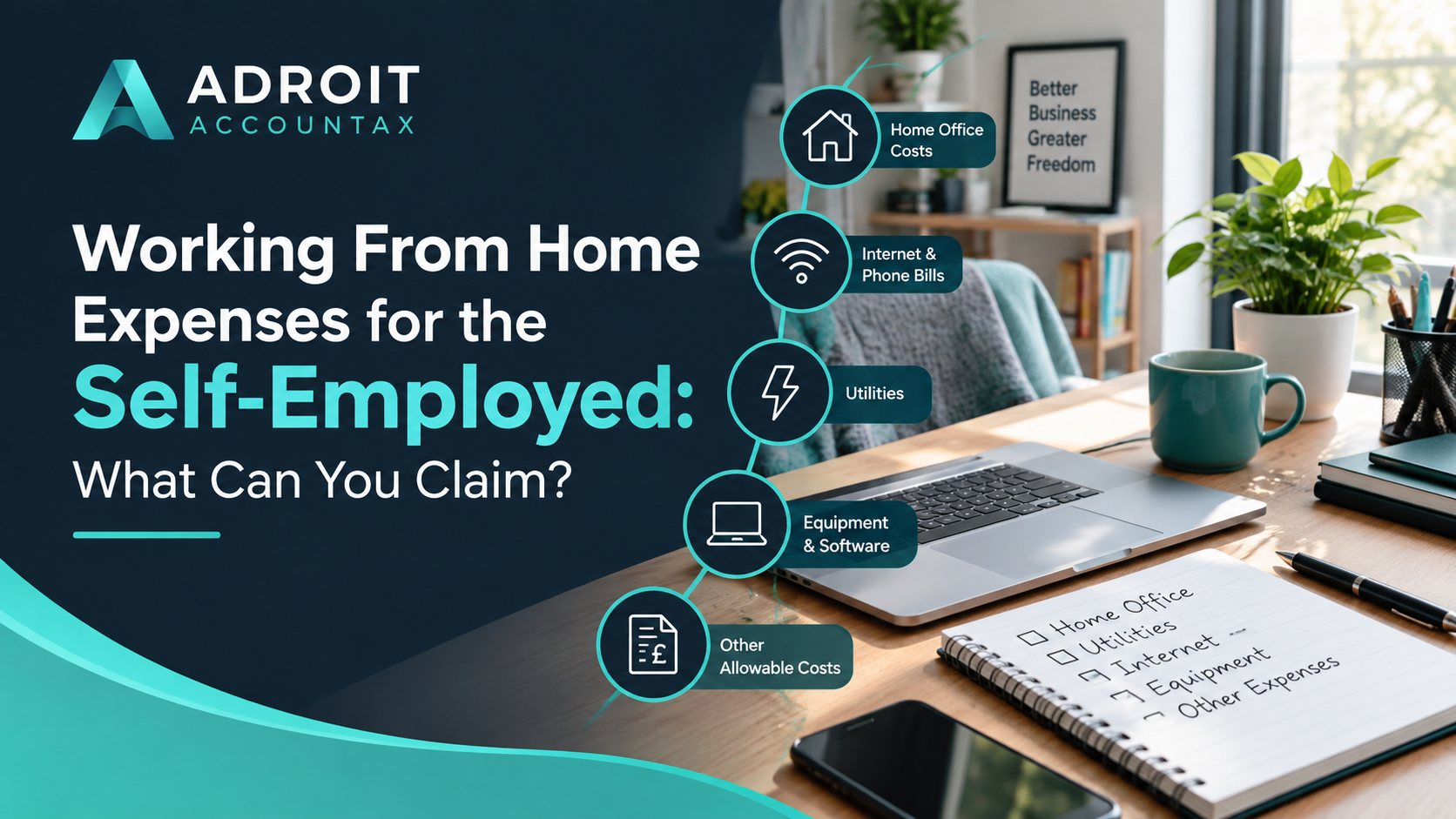
If you are self-employed and use your home for your business, you may be able to claim a reasonable proportion of costs such as:
- Gas and electricity
- Council Tax
- Rent
- Mortgage interest
- Water
- Home insurance
- General household running costs
- Business telephone costs
- Business broadband or internet costs
You normally have two choices for the main household costs:
| Method | How it works | Main advantage |
| Actual costs | Calculate the business proportion of relevant household expenses | Can produce a larger claim where business use and costs are high |
| Simplified expenses | Use HMRC’s fixed monthly rate based on hours worked from home | Much easier to calculate |
The simplified method currently allows:
| Hours worked from home per month | Flat rate |
| 25 to 50 hours | £10 |
| 51 to 100 hours | £18 |
| 101 hours or more | £26 |
The simplified home-working rate covers the relevant household running costs, but it does not include telephone or internet costs. HMRC also allows certain identifiable fixed costs, such as Council Tax, insurance and mortgage interest, to be considered separately where the relevant conditions are met.
What counts as working from home for tax purposes?
Working from home does not necessarily mean you have a dedicated home office.
You might:
- Run your consultancy from a spare bedroom
- Work from your kitchen table
- Use your living room as an office during the day
- Run an online business from your home
- Complete administration from home while working elsewhere
- Meet certain business needs from a home-based office
- Operate your business entirely from your home
The important question is whether you are genuinely carrying out business activities from your home.
For the simplified expenses method, HMRC uses the number of hours you work from home each month.
For the actual-cost method, you need to calculate a reasonable business proportion of the relevant household costs. HMRC gives examples based on factors such as the area used and the amount of time it is used for business.
What home-working expenses can a self-employed person claim?
There is no single percentage that applies to everyone.
Depending on your circumstances, potentially relevant costs include:
Gas and electricity
You may be able to claim the business proportion of household energy costs.
If you use one room as an office, for example, you could consider how much of the property is used for business and how much time that room is used for business.
Council Tax
A reasonable business proportion of Council Tax can potentially be claimed when using the actual-cost method.
Rent
If you rent your home, a reasonable business proportion of the rent may potentially be allowable.
Mortgage interest
If you own your home, the business proportion of mortgage interest can potentially be considered.
This does not mean you can claim the capital repayment element of your mortgage as a business expense.
Water
Where relevant, the business proportion of water costs can be considered.
Insurance
The business proportion of relevant household insurance costs may potentially qualify.
However, you should distinguish between ordinary household insurance and separate insurance specifically taken out for the business.
Internet and telephone
Business use of your internet and telephone can potentially be claimed based on the appropriate business proportion.
These costs are not included in HMRC’s simplified home-working flat rate, so they can be considered separately when using simplified expenses.
There is no automatic “25% of household bills” rule
This is one of the most common misconceptions about working from home.
Suppose you have four rooms and use one as an office.
You might initially think:
1 room ÷ 4 rooms = 25%
So if your electricity bill is £1,200:
£1,200 × 25% = £300
But that does not automatically mean £300 is your allowable business expense.
You also need to consider how the room is used.
For example, if the room is used exclusively as an office throughout the working day, the calculation may be different from a room that is used as an office during the day and a bedroom or family room in the evening.
HMRC’s own examples demonstrate that both area and time of use can be relevant when allocating household costs.
The important principle is:
Your calculation should have a reasonable basis and reflect the actual business use of your home.
How to calculate actual home-working expenses
If you choose the actual-cost method, there is no need to guess.
You can build a reasonable calculation using the parts of your home used for business and the amount of time they are used.
A simple approach is:
Household cost × business-use proportion = potential business expense
But the business-use proportion may itself require more than one calculation.
Example: dedicated office
Imagine:
- Your home has 5 rooms
- One room is used as an office
- The office is used almost entirely for business
- Annual electricity cost = £1,500
If the rooms are broadly comparable in size and usage, you might initially allocate one-fifth:
£1,500 ÷ 5 = £300
If the room is genuinely dedicated to business use, the time calculation may be relatively straightforward.
However, if the room has significant private use, you would need to adjust the calculation accordingly.
This is why you should not blindly use the number of rooms as the only factor.
What if the room is used for both business and personal purposes?
This is extremely common.
You might use your spare bedroom as:
- an office from 9am to 5pm
- a bedroom at night
- a guest room occasionally
Or your dining table might be:
- a workspace during the day
- a dining table in the evening
In these situations, you should take the private use and business use into account.
Example: mixed-use room
Suppose a room represents 15% of your home’s total area.
You use it for business for approximately 8 hours each weekday but use it privately during evenings and weekends.
You should not automatically claim 15% of every household cost.
A reasonable calculation needs to take the business use over time into account.
HMRC’s guidance gives examples where both the proportion of the home used and the proportion of time it is used for business are considered.
Can you claim rent if you work from home?
Potentially, yes.
If you rent your home and use part of it for your self-employed business, a reasonable business proportion of your rent may be allowable.
For example, suppose your annual rent is:
£18,000
You use a particular part of the property for business, and after considering area and time of use, you calculate that a reasonable business proportion is 10%.
The potential business expense would be:
£18,000 × 10% = £1,800
This is an illustration only. The appropriate percentage depends on your actual circumstances.
You should not assume that 10%, 20% or 25% is automatically acceptable.
Can you claim mortgage costs if you work from home?
Potentially, but you need to distinguish mortgage interest from the repayment of the capital.
If you own your home and use part of it for your business, the business proportion of mortgage interest may potentially be allowable under the actual-cost approach.
The capital repayment on your mortgage is not simply an allowable household running cost.
This distinction is important because saying “I pay £1,000 a month on my mortgage” does not mean you can calculate a business percentage of the entire £1,000 and deduct it.
HMRC specifically identifies mortgage interest among the household costs that may be apportioned where a home is used partly for business.
Can you claim Council Tax when working from home?
Potentially.
If you are self-employed and use part of your home for business, you may be able to claim a reasonable business proportion of Council Tax under the actual-cost method.
The calculation should reflect the business use of the property.
For example, if you use one room as an office but the room is also used privately, simply dividing the bill by the number of rooms may not give you the final claimable amount.
HMRC’s guidance includes Council Tax among the fixed household costs that can potentially be apportioned for business use.
What about internet and broadband?
Internet costs are slightly different from the simplified home-working allowance.
HMRC’s simplified home-working rate does not include telephone or internet expenses.
If your internet connection has genuine business use, you can consider the business proportion of the actual cost separately.
Example
You pay:
£40 per month for broadband
If you can reasonably establish that 60% of the use is business-related, the business proportion could be considered:
£40 × 60% = £24 per month
The exact calculation should reflect your actual circumstances rather than using an arbitrary percentage.
If the broadband is entirely business-related, the position may be different, but you should still consider the nature of the contract and any private use.
What about mobile phone costs?
The same principle applies.
If you use your personal phone for both business and private purposes, you should consider the business element rather than automatically claiming the whole bill.
For example:
Monthly phone bill: £50
If £20 represents genuine business use based on a reasonable calculation, you would consider the business element rather than simply deducting the entire £50.
Where a separate phone contract is used exclusively for business, the position can be more straightforward.
Keep evidence of how you arrived at the business proportion.
What are HMRC simplified expenses for working from home?
Simplified expenses allow eligible self-employed businesses to use a fixed monthly rate instead of calculating the actual business proportion of household running costs.
For the current rates:
| Hours worked from home in a month | Claim |
| Less than 25 | £0 |
| 25–50 | £10 |
| 51–100 | £18 |
| 101+ | £26 |
You need to work at least 25 hours from home during the month to use the simplified rate.
The rate is applied month by month.
This means you do not necessarily claim the same amount every month.
How the simplified home-working calculation works
Suppose you work from home:
- 40 hours in April
- 70 hours in May
- 120 hours in June
Your calculation would be:
| Month | Hours | Monthly rate | Claim |
| April | 40 | £10 | £10 |
| May | 70 | £18 | £18 |
| June | 120 | £26 | £26 |
You continue this calculation for each month of the tax year.
HMRC provides an example showing how different monthly rates can be combined depending on the hours worked in each month.
What counts as hours worked from home?
This is worth getting right.
The simplified rate is based on hours of business use of your home, rather than simply counting every hour you happen to be physically present at home.
HMRC describes the relevant activity as core business activities carried out at home.
For example, time spent:
- doing client work
- preparing accounts
- completing business administration
- dealing with customers
- managing your business
- carrying out other genuine business activities
may form part of your working hours.
The simplified rate is based on hours spent carrying out qualifying business activities in your home, rather than simply the number of hours you happen to be at home.
What if you only work from home occasionally?
You do not need to work from home every day to potentially use the simplified method.
The test is applied by month.
For example, you might normally work from a client site or office but work from home more frequently during a particular month.
If you reach the 25-hour threshold during that month, you may be able to claim the relevant simplified rate for that month.
If you work from home for only 15 hours during another month, you cannot claim the £10 rate for that month.
This makes keeping a simple monthly record useful.
Simplified expenses vs actual costs: which is better?
There is no universal answer.
The simplified method is easier.
The actual-cost method can potentially produce a larger deduction.
Consider two self-employed people.
Business owner A
They work from home occasionally and have relatively modest household costs.
Their simplified claim might be:
£26 × 12 months = £312
If their actual business proportion would only be around £250, the simplified method may be attractive because it is easier.
Business owner B
They work from home full-time, have a relatively large home and significant household costs.
Their actual business-use calculation might produce a substantially higher figure than £312.
In that situation, calculating actual costs could be more beneficial.
The key point is:
Simplified expenses are designed for convenience, not necessarily to maximise your deduction.
HMRC provides a simplified-expenses checker specifically because self-employed businesses can compare the simplified method with actual costs.
Can you compare the two methods before choosing?
Yes.
This is one of the best practical steps to take.
Calculate:
Option 1 – Simplified
Add the relevant monthly rates based on your hours worked from home.
Option 2 – Actual
Calculate the reasonable business proportion of relevant household costs.
Then compare the two.
For example:
Simplified expenses: £312
Actual business-use costs: £850
The actual-cost method may produce the larger deduction.
But if:
Simplified expenses: £312
Actual business-use costs: £220
the simplified method may be preferable because it gives a larger deduction with a much simpler calculation.
The comparison should be made using your actual figures rather than assuming one method is always better.
Can you claim internet and phone costs on top of simplified expenses?
Yes, potentially.
This is an important point.
The simplified home-working rate covers certain household running costs, but HMRC specifically states that it does not include telephone or internet expenses.
Where these costs have genuine business use, you can calculate the appropriate business proportion separately using actual costs.
So a self-employed person using simplified expenses might have:
Simplified home-working claim: £312
plus
Allowable business proportion of broadband: £240
plus
Allowable business proportion of phone: £120
Subject to the relevant rules and actual business use, these can be considered separately.
Can you claim office equipment as a home-working expense?
Yes, but do not confuse household running costs with business equipment.
For example, if you buy:
- a laptop
- monitor
- desk
- office chair
- printer
- business software
the tax treatment may need to be considered under the rules applying to business equipment rather than simply adding the cost to your home-working flat rate.
If an item is used for both business and private purposes, the business element may need to be considered.
This is one reason why the simplified home-working rate should not be viewed as an allowance covering every cost associated with your home office.
For equipment specifically, see our separate guide to Business Equipment and Computers: What Can a Small Business Claim?
What if I use one room exclusively as a home office?
Using a room exclusively for business can make the calculation more straightforward, but it can also have property tax implications that you should understand.
In particular, exclusive business use of part of your home can affect the availability of Private Residence Relief when you eventually sell the property.
This does not mean that having a home office automatically creates a Capital Gains Tax bill.
The circumstances matter, including how the room is used and whether there is any non-business use.
HMRC’s guidance on running a business from home specifically warns that Capital Gains Tax can become relevant to the part of a property used for business in some circumstances.
For that reason, if you are considering permanently setting aside a room exclusively for business, particularly in a property you own, it is sensible to discuss the arrangement with an accountant before making the change.
Does working from home affect your Council Tax or business rates?
Not necessarily.
Simply working from home does not automatically mean your home becomes commercial premises.
However, the position can depend on how you use the property and the nature of your business.
For example, there is a significant difference between:
- an accountant doing administrative work from a home office
- a consultant working remotely
- a business storing substantial stock at home
- a business receiving customers at home
- a business using part of the property as dedicated commercial premises
If you have adapted your property significantly for business or regularly receive customers, clients or employees at home, check the position rather than assuming the normal home-working rules cover everything.
Can I claim household furniture for my home office?
It depends on what the item is and how it is used.
A desk or office chair purchased specifically for business use may potentially qualify under the rules for business equipment.
But household furniture that is primarily a personal asset should not automatically be treated as a business expense simply because you sometimes use it while working.
For mixed-use assets, the business use needs to be considered.
For example:
£1,000 sofa used by the family and occasionally while answering emails
is very different from:
£500 office chair purchased specifically for a dedicated work area and used for business.
The purpose and actual use of the item matter.
What records should you keep?
Your records should be good enough to explain how you calculated the claim.
For actual costs, keep:
- Household bills
- Rent statements
- Mortgage interest statements where relevant
- Council Tax bills
- Insurance documents
- Telephone bills
- Broadband bills
- Your calculation of business use
- Notes showing how you determined the area/time allocation
For simplified expenses, keep:
- Monthly records of hours worked from home
- Your calculation of the monthly rates
- Supporting business records showing that the home-working activity took place
HMRC requires businesses to keep records supporting their tax calculations.
You do not necessarily need an elaborate spreadsheet.
A simple monthly record can be enough to establish how many qualifying hours you worked from home.
A practical example: calculating actual costs
Let’s say James is a self-employed consultant.
His annual household costs are:
| Expense | Annual cost |
| Electricity and gas | £1,800 |
| Council Tax | £2,000 |
| Rent | £15,000 |
| Water | £500 |
| Home insurance | £300 |
| Broadband | £480 |
James uses one of five rooms as an office.
The room is used almost exclusively for business during working hours but is also used privately at other times.
He therefore needs to establish a reasonable business proportion for the relevant household costs rather than simply claiming 20% of everything.
Suppose, after considering the area and time of use, he calculates an appropriate business proportion of 10% for the relevant shared household costs.
He could then consider:
- Electricity/gas: £180
- Council Tax: £200
- Rent: £1,500
- Water: £50
- Insurance: £30
The business proportion of broadband would be considered separately because it is not included in the simplified home-working rate.
The total actual claim would then depend on the precise calculation and circumstances.
The figures above are only an illustration. The correct percentage should come from the actual use of the property.
A practical example: simplified expenses
Now suppose another sole trader works from home throughout the year.
Their monthly home-working hours are:
- 10 months at 101+ hours
- 2 months at 70 hours
Their simplified calculation would be:
10 × £26 = £260
2 × £18 = £36
Total = £296
They can then consider qualifying telephone and internet business costs separately because these are outside the simplified home-working rate.
The important thing is that the calculation is based on the hours worked from home in each month, rather than simply multiplying £26 by 12 because the person works from home generally.
Common mistakes when claiming working from home expenses
Mistake 1: Claiming 25% of everything
There is no universal 25% rule.
The calculation should reflect the actual business use of your home.
Mistake 2: Claiming your entire electricity bill
Your household electricity is normally partly personal.
You need to establish a reasonable business proportion unless using the relevant simplified method.
Mistake 3: Claiming the entire mortgage payment
Mortgage capital repayments are not the same as mortgage interest.
Only the relevant allowable element should be considered.
Mistake 4: Assuming a home office means everything in the room is deductible
Personal items do not automatically become business expenses because they are located in an office.
Mistake 5: Claiming simplified expenses and actual household costs for the same costs
You should not use the simplified home-working rate and then claim the same household running costs again under the actual-cost method.
Mistake 6: Forgetting telephone and internet
These are not included in HMRC’s simplified home-working rate and can potentially be considered separately based on actual business use.
Mistake 7: Guessing your home-working hours
If you use simplified expenses, keep a simple record of your monthly hours.
Mistake 8: Treating working from home as the same as being employed
The rules for self-employed people and employees are different.
What changed for employees working from home in 2026?
This distinction is particularly important from 6 April 2026.
Employees can no longer claim an Income Tax deduction from HMRC for unreimbursed additional household costs incurred because they work from home.
This is different from the rules for self-employed people.
The removal of the employee tax deduction does not remove the self-employed rules described in this article. Eligible self-employed businesses can continue to use the actual-cost method or HMRC’s simplified expenses method.
So if you see an article saying:
“You can no longer claim working-from-home expenses in 2026”
be careful.
That statement is too broad.
The 2026 change concerns the employee tax relief for unreimbursed home-working expenses, not the self-employed simplified-expenses rules.
Can an employer still pay an employee for working from home?
Yes.
The 2026 removal of the employee deduction does not prevent an employer from reimbursing qualifying additional home-working costs.
HMRC guidance confirms that employers can continue to reimburse eligible home-working expenses without Income Tax and National Insurance deductions, subject to the relevant conditions.
This is separate from the self-employed simplified rates of £10, £18 and £26 per month.
Do not mix the two systems.
What about limited company directors working from home?
A director of a limited company needs to be careful not to simply apply the sole-trader rules to themselves.
A limited company is a separate legal entity.
The self-employed simplified home-working rates are designed for eligible sole traders and qualifying partnerships; they are not a method a limited company can simply use for its director’s home-working costs. HMRC’s simplified-expenses guidance is specifically framed around self-employed businesses.
A director working from home may instead have qualifying additional household costs reimbursed by the company, subject to the relevant rules.
There can also be different considerations where:
- the company pays rent for use of the home
- a room is used exclusively for business
- the director has a formal home-working arrangement
- the company provides equipment
- the director uses personal assets for company purposes
If you operate through a limited company, it is therefore worth getting the arrangement right rather than simply claiming £26 per month because you work from home.
What if I work from home and from another workplace?
This is common for consultants, contractors, tradespeople and other mobile businesses.
You may:
- work from home two days a week
- visit clients three days a week
- occasionally work from a rented office
- travel to temporary workplaces
Your home-working expenses and your business travel expenses are separate issues.
For example, if you work from home and then travel to a client, you need to consider the travel rules separately.
Do not assume that because you work from home, every journey from your home is automatically a business journey.
The nature of your workplace arrangements matters.
For more information, see our guide to Business Mileage and Travel Expenses: What Can Small Businesses Claim?
Can I claim for a home office if I only work there occasionally?
Potentially, yes.
There is no rule saying you must work from home every day.
For simplified expenses, however, you need to meet the relevant monthly hours threshold.
If you work fewer than 25 hours from home during a particular month, you cannot use the simplified home-working rate for that month.
Under the actual-cost method, the calculation works differently and depends on the actual business use of your home.
Which method should you use?
For most self-employed people, the decision comes down to simplicity versus the size of the deduction.
Simplified expenses may suit you if:
- You want a straightforward calculation
- You work from home regularly
- Your actual household business costs are relatively low
- You do not want to calculate room and time allocations
- The simplified rate produces a similar or higher deduction
Actual costs may suit you if:
- You work from home extensively
- Your household costs are relatively high
- You use a significant part of your home for business
- You have substantial rent or qualifying household costs
- Your actual business proportion is likely to exceed the simplified amount
There is no requirement to choose the method that sounds more sophisticated.
Choose the method that is appropriate to your circumstances and produces a supportable calculation.
HMRC specifically recognises that eligible businesses can choose between simplified expenses and actual costs for working from home.
A simple decision process
Before claiming home-working expenses, work through these questions:
1. Are you self-employed?
If you are an employee, different rules apply.
2. Do you genuinely work from home?
Identify the business activities you carry out at home.
3. Do you meet the simplified-expenses threshold?
If you work at least 25 hours from home in a month, you may be able to use the relevant flat rate for that month.
4. What would your actual costs look like?
Calculate a reasonable business proportion of relevant household expenses.
5. Compare the two methods
Work out whether simplified or actual costs produce the more useful deduction.
6. Check costs outside the simplified rate
Telephone and internet are important examples.
7. Keep your evidence
Keep the bills, calculations and home-working records needed to support your claim.
Frequently Asked Questions
How much can a self-employed person claim for working from home?
Under HMRC’s simplified expenses method, the current monthly rates are £10 for 25–50 hours, £18 for 51–100 hours and £26 for 101 or more hours worked from home in a month. You can alternatively calculate your actual business proportion of qualifying household costs.
Can I claim £26 every month if I work from home?
Only if you work 101 or more qualifying hours from home during that particular month. The simplified rate is calculated monthly rather than automatically giving everyone £26 for every month of the tax year.
Can I claim working from home if I am a sole trader?
Yes, potentially. Sole traders can use either the actual-cost method or HMRC’s simplified expenses method, provided they meet the relevant conditions.
Can I claim internet costs as well as simplified home-working expenses?
Potentially, yes. HMRC specifically states that telephone and internet expenses are not included in the simplified home-working flat rate, so the appropriate business proportion can be calculated separately.
Can I claim Council Tax if I work from home?
Potentially. Under the actual-cost method, a reasonable business proportion of Council Tax can be considered where your home is used for business.
Can I claim rent if I work from home?
Potentially. A reasonable business proportion of rent may be allowable where you use part of your home for your self-employed business. The calculation should reflect the actual business use.
Can I claim mortgage payments if I work from home?
You should distinguish between mortgage interest and capital repayments. The business proportion of qualifying mortgage interest may potentially be considered, but you cannot simply claim a percentage of the entire mortgage repayment.
Can I claim my entire electricity bill?
Generally not. You need to distinguish between private and business use when calculating actual costs. Alternatively, eligible self-employed businesses can use the simplified home-working rate instead.
Can I claim a home office if I also use the room personally?
Potentially, but you need to take the private use into account when calculating actual costs. A room that is used for both business and personal purposes should not automatically be treated as entirely business use.
Can I use simplified expenses and claim my household bills separately?
Not for the same household running costs covered by the simplified rate. The simplified method is intended to replace the need to calculate those actual household costs. However, telephone and internet costs are outside the simplified home-working rate and can potentially be considered separately.
Do employees have the same working-from-home rules as sole traders?
No. The rules are different. From 6 April 2026, employees can no longer claim an Income Tax deduction from HMRC for unreimbursed additional home-working costs, while the self-employed home-working rules continue.
Can a limited company director use the £26 simplified rate?
Not simply on the basis that they are a director working from home. HMRC’s simplified expenses method applies to eligible self-employed businesses, not as a general home-working allowance for limited companies. A director’s home-working arrangements need to be considered under the rules applying to the company and its director.
Do I need a separate room to claim home-working expenses?
No. You can work from a shared room or another part of your home. What matters is the business use and, where calculating actual costs, a reasonable allocation of the relevant expenses.
Do I need receipts for the simplified home-working rate?
You do not need to calculate receipts for each household cost to use the simplified rate, because it is a flat-rate method. However, you should keep appropriate records of your qualifying hours and business activity and retain the records required to support your tax return.
Key Takeaways
Working from home can create a legitimate business expense for a self-employed person, but there is no automatic percentage of household bills that everyone can claim.
You generally have two options:
Actual costs:
Calculate a reasonable business proportion of relevant household expenses.
Simplified expenses:
Use HMRC’s monthly rate based on the number of hours you work from home.
For the current rates:
- 25–50 hours: £10 per month
- 51–100 hours: £18 per month
- 101+ hours: £26 per month
Telephone and internet costs are not included in the simplified home-working rate and can potentially be considered separately based on actual business use.
The simplified method is not automatically better. If you have significant household costs or extensive business use of your home, calculating actual costs may produce a larger deduction.
The most important thing is to have a reasonable calculation that you can explain and support.
And remember that the rules for a sole trader are not the same as those for an employee or a limited company director.
Need help calculating your home-working expenses?
Working out the correct business proportion can be straightforward in some cases and surprisingly complicated in others, particularly where a room has mixed business and private use or where you operate through a limited company.
Adroit Accountax can help you review your home-working arrangements, compare simplified expenses with actual costs and make sure your business expenses are recorded correctly.
If you are a sole trader, freelancer or small business owner in London and want help with your tax and accounts, speak to our Small Business Accountants in London.
Quick answer: Small businesses may be able to claim genuine costs incurred for business purposes, such as office expenses, software, professional fees, advertising, insurance, qualifying business travel, staff costs, stock and certain equipment. The exact rules vary depending on the expense and the structure of the business.